Posted by Abu Iyaad
Monday, Mar 17 2025
Filed under Misconceptions
The revealed legislation (al-sharʿ al-munazzal) is what Allāh sent His Messenger (صلى الله عليه وسلم) with, and scholars make ijtihād and taʾwīl (interpetations) of this legislation. They may arrive at the truth in the affairs in which they investigate—applying or deriving rulings to a situation or issue, according to their understanding—in which case they are rewarded twice, or they may not. When a person knows that the truth lies in someone else’s saying, it is not permissible for him to reject it for the saying of any other person, whoever it might be.
Shaykh al-Islām Ibn Taymiyyah (رحمه الله) said:
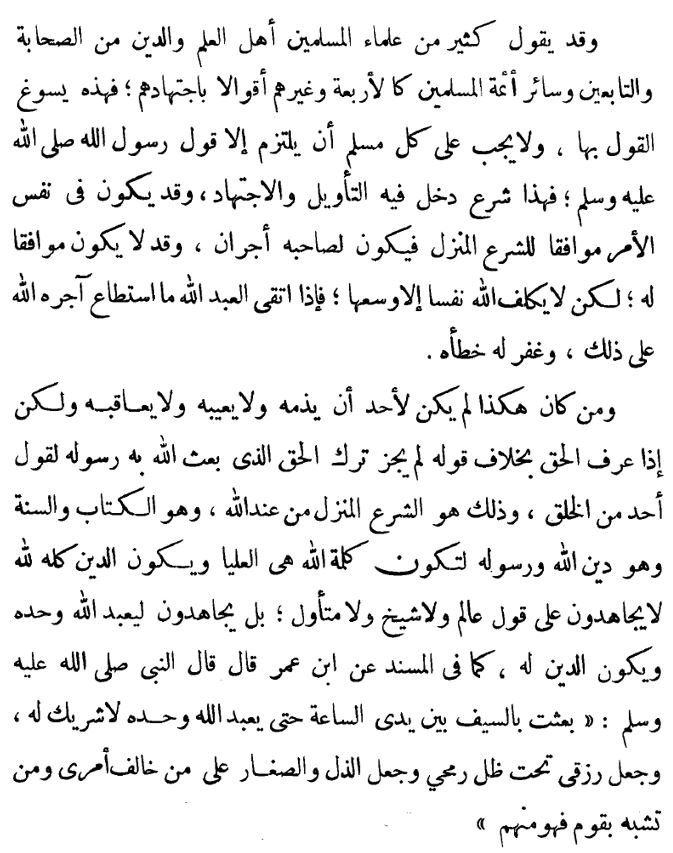
Sometimes, many of the scholars of the Muslim—the People of Knowledge and Religiosity, from the Companions, the Successors, and all the Imāms of the Muslims, such as the Four Imāms and others—may have statements based on their ijtihād. It is permitted to speak with them.
However, it is not obligatory upon every Muslim to accept and adhere to [the saying of anyone] except the saying Allāh’s Messenger (صلى الله عليه وسلم).
Interpretation (taʾwīl) and ijtihād have entered into this legislation, and such (ijtihād) may, in itself, be in agreement with the revealed legislation (al-sharʾ al-munazzal), hence the person is given two rewards, or it may not be in agreement with it.
However, Allāh does not burden a soul with more than it can bear. So when a person fears Allāh as much as he is able, Allāh will reward him for that, and will forgive him his sin. And whoever is like this [i.e. the pursuer of truth, even if he errs in ijtihād], it is not for anyone to blame him, criticise him, or to punish him.
However, when he knows that the truth is someone else’s speech, it is not permissible for him to abandon the truth which Allāh sent His Messenger with due to the saying of anyone from the creation.
This (truth) is the revealed legislation (al-sharʿ al-munazzal) from Allāh, and that is the Book and the Sunnah, it is the dīn of Allāḥ and His Messenger so that Allāh’s word can be uppermost and so that all devotion (dīn) is for Allāḥ.
They do not make jihād for the saying of a scholar, or a shaykh, nor an interpreter (mutaʾawwil) [of the legislation]. Rather, they fight so that Allāh is worshipped alone and so that the religion is for Him alone.
As occurs in the Musnad, from Ibn ʿUmar who said; The Messenger of Allāh (صلى الله عليه وسلم) said: “I was sent with the sword prior to the Hour so that Allāḥ is worshipped alone, without any partners. My sustenance was placed beneath the shade of my spear. And lowliness and humiliation is for the one who opposes my command, and whoever resembles a people is among them.”[1]
Arabic Text:
Footnotes
1. Ṣaḥīḥ al-Jāmiʿ al-Ṣaghīr (no. 2831).